Right turns when driving on the left
Right turns are one of the strangest moments when you are driving on the left for the first time. The rule may be simple, but the habit is not. If you normally drive on the right, your brain has years of practice looking, turning, and settling into the lane from the opposite pattern.
That is why a right turn can feel fine in theory and still go wrong in the moment.
Why right turns feel strange
When you turn right in left-hand traffic, several things change at once:
- you are crossing traffic from a different road position
- you need to check for oncoming traffic from the correct direction
- you must turn into the left side of the road
- your old lane-position habit can pull you toward the wrong side after the turn
The risky moment is not only the turn itself. It is often the few seconds after the turn, when your old driving habit quietly takes over again. The science of muscle memory describes this drift in more detail.
Looking the wrong way for oncoming traffic
The most concrete failure mode for a right turn in left-hand traffic is also the most subtle: your eyes look the wrong way before the turn.
In right-side-driving countries, the oncoming traffic for a right turn comes from the left. Your brain has spent years scanning that direction first. Now you are driving on the left, turning right means crossing the oncoming lane, and that traffic is on the right - but the muscle-memory check still goes left, and the right-side scan is shorter, faster, and easier to miss. The risk is not that you forget to look. The risk is that you look in the order that used to be correct.
The override is to say it out loud, slowly, the first few times: "Look right, then left, then right again." That cue feels artificial. That is the point - the cue is doing the work your reflex used to do.
Turning into the left side of the new road
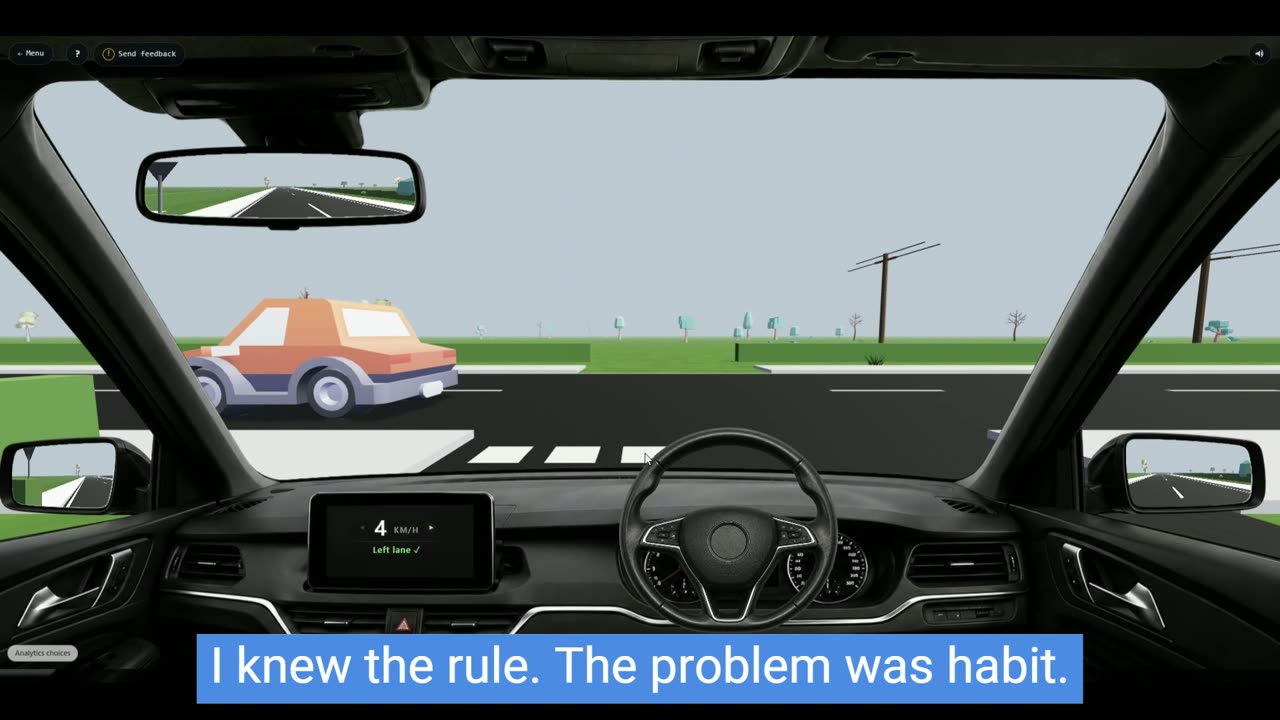
When you turn right from a left-side road, the arc your hands want to draw is the arc you have always drawn. From the United States or continental Europe, that arc lands the car on the right side of the new road. In left-hand traffic, that is the wrong side, head-on into oncoming traffic.
The fix is geometric: the turn must go further around - the steering wheel turns more, and the car aims toward the far side of the new road from your starting point. Your headlights should end the turn pointing down the left side of the road, not the right.
The danger is rarely the moment you realize the mistake. It is the half-second of correction in the middle of the turn, with your eyes searching for the lane while the car is still mid-rotation. Slow the turn down. Pause before starting it. Commit to the correct arc.
Here is the same mistake, made and then corrected. The first run turns into the near lane, which is where a right-driving habit expects the road to be. The coaching catches it. The second run takes the far lane.
The habit to rehearse
Before a right turn, slow the whole moment down:
- Pause before the turn.
- Look for oncoming traffic from the correct direction.
- Turn into the left side of the road.
- Keep left after the turn.
- Reset before accelerating.
That pause matters. It gives your brain time to override the old automatic pattern. Clockwise roundabouts and right-hand turns walks through the geometry that makes the turn itself feel different.
Post-turn drift
A right turn is over when the car is straight. The danger continues for another five to fifteen seconds.
In that window, your hands relax, your eyes return to the road, and your brain quietly hands control back to instinct. If old instinct says "the driver belongs near the left side of the lane" - the default for right-side-driving countries - the car will drift right. In left-hand traffic, drifting right puts you toward the center line, then over it.
The practical fix: after every right turn, say "left side, left lane" out loud until the car is settled. That cue interrupts the handoff and gives the new pattern an extra few seconds to win.
Where right turns are hardest
Right turns in left-hand traffic feel different depending on where you are. In Ireland, the right turn is often at a junction that doubles as a roundabout, with little time to plan. In Cyprus, a right turn off a busy ring road gives oncoming traffic less margin for hesitation. In Scotland's single-track roads, the right turn is often blind, into a road you cannot see down. In New Zealand, the right turn off State Highway 1 can come faster than the speed limit suggests.
Same habit, different conditions. The rehearsal is the same.
Why LeftLane focuses on this
LeftLane was built around this exact mistake - a first left-side drive, a right turn, and eyes looking the wrong way for oncoming traffic.
That is the kind of moment that is easy to understand afterwards, but difficult to prevent when the road, car, traffic flow, and habits all feel unfamiliar at once. More on why LeftLane exists.
Practice right turns before pickup day
LeftLane includes short practice scenarios for the moments where right-side-driving habits are most likely to come back. It is one of several scenarios in the driving-on-the-left simulator. If you are about to collect the car, the rental car pickup checklist walks through the first 15-30 minutes calmly.
New here? Try the 60-second controls tutorial first →
FAQ
Why are right turns the hardest part of driving on the left for the first time?
A right turn in left-hand traffic requires three habit overrides at once: looking for oncoming traffic from the opposite direction, turning into the left side of the new road, and keeping left after the turn instead of drifting back to the old lane position. Any one of these can be remembered consciously. The danger is doing all three under time pressure on the first real drive.
Which way should I look before turning right in left-hand traffic?
Oncoming traffic now comes from the right. The full check is right, then left, then right again - but the order matters: the right check has to come first, because that is the direction your old habit will not check on its own. Saying it out loud for the first few turns is not silly. It is the cue that overrides the reflex.
What is post-turn drift?
It is the slow drift back toward the old lane position in the five to fifteen seconds after a turn is complete. The turn itself uses conscious attention; once the car is straight, conscious attention relaxes and old instinct takes over again. In right-side-driving instinct, the driver sits near the left side of the lane - which in left-hand traffic is exactly where the center line is. The fix is a verbal cue immediately after the turn: "left side, left lane."
How can I practice right turns before pickup day?
LeftLane includes practice scenarios designed around the right-turn failure mode - a deliberate setup with oncoming traffic, the wrong-way eye scan, the turn arc, and the post-turn drift window. They run in a browser, take a couple of minutes each, and can be repeated until the habit feels less strange. They are designed for rehearsal before the trip, not for learning to drive.
LeftLane is a browser-based habit-rehearsal tool. It is not a full simulator, not a driving school, and not a rules course. Always follow local road laws, official guidance, and real-world driving judgment. See the pre-trip checklist for the calm-down playbook before the first day.