Driving in Cyprus: Roundabout Rules and a Calmer First Day After Pickup
Cyprus drives on the left, uses kilometers per hour, and runs roundabouts clockwise. Here is what visitors need to know before a rental-car pickup at Larnaca or Paphos.
Cyprus roundabout rules: quick answer
- Cyprus drives on the left.
- Roundabouts circulate clockwise.
- Give way to traffic already on the roundabout from your right.
- Choose your lane before you enter - follow the signs and lane markings.
- Don't cut across lanes inside the circle; leave from the correct lane.
- After your exit, reset into the left lane.
The Cyprus adjustment, in one paragraph
Yes, Cyprus drives on the left - a legacy of the British colonial period. Yes, your rental car will almost certainly be right-hand drive, with the steering wheel on the right. You overtake on the right, give way at roundabouts to traffic from your right, and finish every turn in the left lane. The mechanics are universal across left-hand traffic. What makes Cyprus distinctive is everything around the driving: the metric speeds, the heat, and the Mediterranean rhythm of the road.
The single biggest mistake American visitors make: misreading the speed
Cyprus uses kilometers per hour. The motorway limit is typically 100 km/h - which is about 62 mph, not 100 mph. Main roads are usually 80 km/h (~50 mph). Urban roads are typically 50 km/h (~31 mph).
American drivers who have not deliberately switched their internal speedometer often read “100” on a sign and unconsciously treat it as mph for a fraction of a second. That fraction is enough to push the foot down. The instinct is fast; the correction is slower than you think.
Cyprus roundabout rules for tourists
Roundabouts are a defining feature of Cyprus driving, especially along the coastal tourist corridor - Paphos, Limassol, Larnaca, and the routes between them. The A1 (Nicosia to Limassol), A6 (Limassol to Paphos), and A5 (eastward toward Ayia Napa and Protaras) all feed roundabout-heavy entry sections into the towns they serve.
The Cyprus roundabout rules are the same as the rest of the left-driving world. Cyprus roundabouts circulate clockwise: you give way to traffic already on the roundabout from your right, choose your lane on approach (not inside the circle), and signal left as you pass the exit before yours.
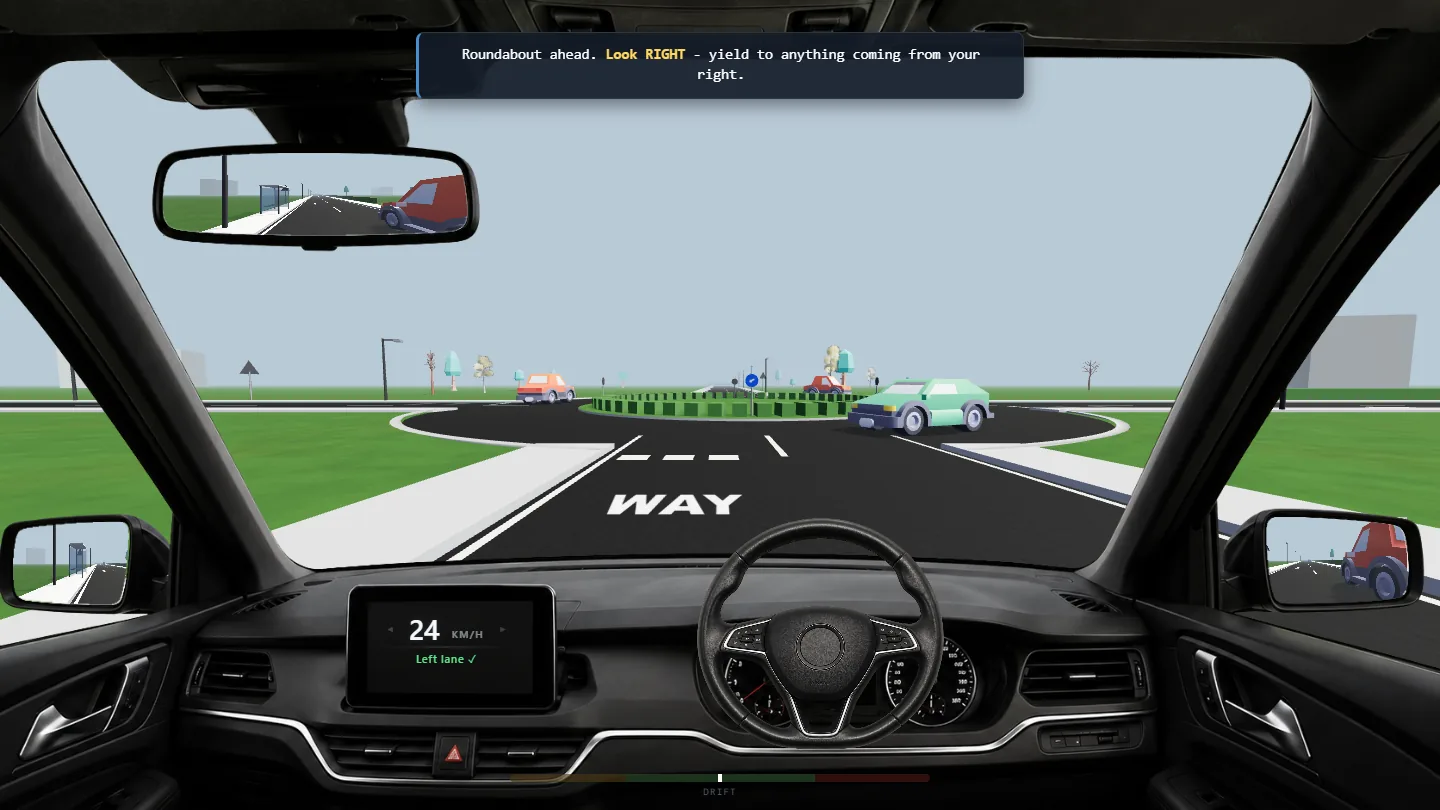
The geometry, including the lane choice and the post-turn drift that is the most common failure mode after a roundabout exit, is unpacked in 360° Vision: Clockwise Roundabouts and Right-Hand Turns. Rehearse it before pickup - especially the part about landing in the left lane after every roundabout exit.
The first ten minutes after pickup at LCA or PFO
Most Cyprus trips begin with a rental pickup at Larnaca (LCA) or Paphos (PFO) airport. The drive out is straightforward in lane terms but cognitively loaded: you are tired from the flight, the car is reversed, the speeds are metric, and the first hot dry gust hits you the moment you open the door.
Before you leave the lot:
- Adjust the seat, both side mirrors, and the rearview mirror.
- Find the lights, hazard button, and parking brake.
- Switch your internal speedometer to km/h before moving - not at 80 km/h on the A1.
- Set the route before pulling out, not while creeping in traffic.
- Confirm whether the first turn out of the lot is left or right.
- Say out loud: “Start left, finish left.”
- Drink water. Set the AC.
- Ask a passenger to read junctions aloud for the first hour.
The country-neutral rental car pickup checklist walks through the same first 30 minutes without the Cyprus-specific heat tax.
The heat tax
From late spring through early autumn, Cyprus is hot. August afternoons routinely exceed 35 degrees Celsius (95 degrees Fahrenheit), and the coastal towns can feel hotter still with sun glare off the road and the sea.
Heat compounds with the left-side adjustment. Tired plus dehydrated plus reversed cabin plus metric speeds is more than most drivers account for. The Mediterranean siesta tradition exists for a reason - the worst time to make your first left-side drive is the hour the locals avoid the road.
The worst time to make your first left-side drive in Cyprus is the same hour locals avoid the road. Plan around it.
Practical heat moves:
- Carry at least one bottle of water per person in the car.
- Park in shade where possible - the steering wheel temperature alone can hit unbearable in direct sun.
- If pickup is afternoon and your hotel is more than 30 minutes away, consider an evening departure instead.
- Sunglasses are not optional on the A1 or A6 around midday.
Where you'll actually drive: Paphos, Limassol, Larnaca, Nicosia, Ayia Napa, Troodos
Most visitors stay along the south coast and only briefly venture inland. The road environment differs by destination, and the left-side adjustment plays out differently in each:
- Paphos & the west coast. Roundabout-heavy approaches, tourist drivers on scooters and quad bikes, and narrow village lanes once you head off the main road toward inland sites.
- Limassol. The biggest city you are likely to drive in. Dense traffic, frequent roundabouts, and the long seafront drive where lane discipline matters because the road changes lane count without much warning.
- Larnaca. Compact, manageable, the typical first-drive city for arrivals at LCA. The drive to or from the airport is one of the easiest first routes on the island.
- Nicosia. Inland capital. Heavier traffic, older street layout in the center, and the only place you are likely to encounter the buffer zone between the Republic of Cyprus and the north.
- Ayia Napa & Protaras. Resort towns. Heavy tourist scooter and quad bike traffic in summer. Many of those riders are inexperienced - assume nothing about their lane positioning.
- Troodos mountains. Narrow, winding roads up into the mountain villages. Slow down hard for blind bends. The temperature drops noticeably with altitude, which is pleasant in August and unpleasant in winter when the higher passes can ice.
Drink-drive and the practical visitor rule
Cyprus enforces a drink-drive limit that is in line with most of the European Union, with a lower limit for new and professional drivers. Limits, fines, and license rules change, so confirm the current details before you travel with an official source such as the EU's Your Europe guide to road rules in Cyprus or the Cyprus tourism board's guide to driving in Cyprus, and always follow posted signs and local law. The practical visitor rule is the simple one: do not drink and drive in Cyprus. The combination of alcohol, heat, jet lag, and an unfamiliar cabin is a stack you do not want to add a fourth layer to.
What visitors usually worry about
“Will I forget and end up on the wrong side?”
The risk window is after a stop, a turn, or a long quiet stretch with no oncoming traffic to anchor against - and the uneasy sense that you are driving on the wrong side of the road is old habit, not a real mistake. The verbal cue “Start left, finish left” exists for that moment. Use it every time you pull out for the first day.
“Manual or automatic?”
If this is your first left-side drive, pay extra for an automatic. Manual rentals are widely available in Cyprus, but shifting with your left hand while also managing the left-side traffic, the metric speeds, the heat, and the roundabouts is a lot for day one.
“Should I drive straight after landing?”
If you are jet-lagged and arriving in summer heat, no. Pick a hotel near LCA or PFO for the first night, sleep, hydrate, and start driving in the morning. The post-turn drift fires harder when you are tired.
What to practice before Cyprus
Of all the driving-in-Cyprus tips you will read, the highest-leverage one is not memorizing Cypriot road signs. It is rehearsing the four moments where habit fails:
- Pulling out onto the road in the left lane after a stop.
- Right turns across oncoming traffic, landing in the left lane on the far side.
- Entering and exiting a clockwise roundabout without drifting on the way out.
- Holding lane position for the three seconds after any turn, when post-turn drift fires.
The free, browser-based driving on the left simulator runs these as standalone scenarios you can repeat until the new pattern fires by default. The brain-side of why it works is unpacked in muscle memory and the drift after a turn; the geometry side in 360° Vision, and the right turn across oncoming traffic has its own step-by-step walkthrough. Quiet forecourts catch people out too - the deliberate-pause fix is in petrol-station exits when driving on the left. For a country-neutral pre-trip checklist, see Tips for Adjusting to Left-Hand Driving.
Frequently asked questions
Does Cyprus drive on the left?
Yes. Cyprus drives on the left, a legacy of the British colonial period. Most rental cars are right-hand drive, with the steering wheel on the right side of the cabin. For visitors arriving from mainland Europe or North America, this is the biggest single adjustment of the first day.
Is driving in Cyprus difficult for tourists?
It is manageable for most confident drivers, but the first day stacks several adjustments at once: left-side traffic, right-hand-drive cars, metric speed limits, heat, and an unfamiliar road style around Limassol, Paphos, Larnaca, and Nicosia. Practice the habit-change moments before pickup and keep the first drive short.
Are roundabouts common in Cyprus?
Very common, especially around Paphos, Limassol, and Larnaca, and on the main roads connecting them. Cyprus roundabouts circulate clockwise like the rest of the left-driving world. Give way to traffic already on the roundabout from your right, choose your lane on approach, and signal left as you pass the exit before yours.
What are the Cyprus roundabout rules?
Cyprus drives on the left, so roundabouts circulate clockwise. Give way to traffic already on the roundabout from your right, follow the signs and lane markings on approach, and reset into the left lane after your exit. This is a quick orientation for visitors, not a substitute for local signs and law, so always follow current Cypriot road rules on the day.
What is the speed limit in Cyprus?
Cyprus uses metric units. The motorway speed limit is typically 100 km/h (about 62 mph), main roads are usually 80 km/h (about 50 mph), and urban areas are typically 50 km/h (about 31 mph). Posted limits override these defaults; always follow the signs.
Should I rent an automatic in Cyprus?
If this is your first left-side drive, yes. Automatic rentals are widely available in Cyprus. The combination of left-side traffic, a right-hand-drive cabin, metric speeds, roundabouts, and summer heat is a lot for day one; an automatic removes one cognitive load while you adapt.
Should I practice before renting a car in Cyprus?
It helps. A few reps of the moments where habit fails, such as roundabouts, right turns across traffic, and keeping left after a turn, make the first day feel less like a test. LeftLane is a free browser practice tool for exactly those moments, not a driving school and not a substitute for local road rules. Practice the habit switch before pickup, then drive carefully and follow Cypriot law on the day.
Reps on the moments that matter on a Limassol roundabout.
The right turn across traffic. The clockwise roundabout. The three-second window after a turn where post-turn drift fires. LeftLane runs each as a standalone scenario you can repeat until the new pattern feels normal - before you meet the A6 entry to Paphos for real.
Start the simulator →